Keeping production running smoothly is the ultimate goal of every manufacturing and process plant. From the strict hygiene demands of dairy and beverage production to the high-precision environments of plastics, rubber, and advanced printing, temperature control systems are the backbone of industrial operations
Efficiency, reliability, and longevity are critical considerations in managing closed-circuit process cooling and chillers. Yet, when machines break down unexpectedly and water-related problems halt production, maintenance managers and operators know the hassle and cost all too well.
In today’s highly competitive business landscape, minimising operating costs and mitigating risk while maintaining operational and energy efficiency is paramount. Experienced plant and facility managers know that deferring regular maintenance to save money in the near term is a poor practice that will likely cost the organisation far more in the long term. Delaying maintenance on complex process cooling applications places crucial assets at risk of extensive damage and expensive repairs. Decreased system life, reduced reliability, higher failure rates, and increased downtime are the typical byproducts of procrastinating on seasonal upkeep.
While sub-zero temperatures can create severe physical pressures on outdoor equipment, autumn is the perfect time for a thorough system review and the application of proactive, customised maintenance measures. It is also an opportune moment to consider how your system can be enhanced to reduce operating costs, future-proof your facility, and transition toward sustainable decarbonisation.
Water Treatment: The First Line of Chemical Defence
A process cooling system is only as reliable as the fluid circulating within it. A robust water treatment plan is essential for the longevity, efficiency, and reliability of process equipment, protecting against corrosion, leaks, system deterioration, and the accumulation of rust, scale, biofouling, and debris.
In winter, glycol (antifreeze) is vital to lower the freezing point of the chilled water and prevent fluid from freezing inside the system. However, securing the system involves more than simply adding glycol; its chemical quality and concentration matter just as much as its volume.
- The Danger of Automotive Antifreeze: It goes without saying that automotive antifreeze must never be used in commercial or industrial chilled water systems. Formulated for engine cooling, it can cause major problems with system flow rates, altered pressures, and significantly reduced heat transfer. For industrial closed circuits, only high-quality inhibited glycol engineered specifically for these applications should be used.
- The Necessity of Inhibitors: Uninhibited glycol-water mixtures are highly corrosive. Inhibited glycol plays a crucial role in protecting the hydraulic circuit, containing specialised additives that buffer pH, prevent pipework corrosion, control scale, and suppress biological growth.
- The 25% Threshold: It is best practice to maintain a minimum glycol concentration of 25%. Falling below this threshold means there are insufficient inhibitors present, turning the system into a feeding ground for bacteria and leaving it vulnerable to freezing. Conversely, over-mixing or exceeding the necessary concentration can be counterproductive, increasing fluid viscosity and placing unnecessary strain on pumps.
- Preventing Chemical Contamination: Mixing different types or brands of glycol should be avoided. Chemical incompatibilities can lead to formula separation, resulting in a thick sludge that clogs filters, strainers, and pump suctions, while compromising thermal properties. Dedicated, labelled transfer equipment should always be used to prevent cross-contamination.
Furthermore, simply adding glycol is not enough. Prior to introducing a new water/glycol solution, the entire hydraulic circuit must be thoroughly flushed, cleaned, and sanitised. Because water chemistry varies, “one-size-fits-all” products rarely deliver optimal protection. Facilities should arrange a professional fluid analysis on every hydraulic circuit before introducing glycol to identify appropriate inhibitors and establish a baseline quality. Regular sample testing and the centralised logging of fluid trends will provide early warnings of progressive contamination or corrosion.
Reversing “Chocolate Milk” and Downtime at IG Design Group UK
To understand the real-world impact of neglecting water chemistry, one only has to look at the challenges faced by IG Design Group UK at their Glamorgan site in Wales. The plant is home to advanced vacuum metallisers and high-speed printing machinery operating under demanding conditions. The vacuum metallisers operate at extreme temperatures —evaporating aluminium at 1,500 °C and then chilling the foil to –15 °C, — placing immense thermal stress on internal components. Meanwhile, printing-press chillers must maintain water at 18–22 °C to preserve ink viscosity, drum concentricity, and paper-drying performance.
Like many manufacturers, IG Design Group began to notice their systems were showing signs of strain. Driven by uncontrolled water pH, corrosion began to damage internal machine components made from a delicate mix of steel, brass, copper, and aluminium. At times, the water in the printing circuits appeared thick and sludgy, which the operators likened to “chocolate milk.” This sludge triggered sensors, halted presses, and forced the team into frequent cleanups, interrupting production flow and increasing operational headaches.
Our in-house water treatment specialists conducted a detailed site survey, followed by on-site water sampling and laboratory analysis to establish clear treatment targets. Working collaboratively with the onsite team, service engineers made targeted adjustments, including fine-tuning the chill-water set point in the metalliser’s chiller to stabilise operating temperatures and benefit overall press performance. They performed a comprehensive purge of the coolant in the metalliser circuit to remove scale and corrosive residues and cleaned the printing-press drums and heat exchangers to restore efficient heat transfer.
To arrest further corrosion, a bespoke dosing programme was developed to rebalance the water chemistry. The solution was reinforced by proactive maintenance, scheduling quarterly site visits for water sampling, chemical replenishment, and detailed inspections of pumps, filters, and sensors. Additionally, a phased upgrade to side-stream filtration was proposed to capture fine particulates before they could accumulate as sludge.
The results of the intervention were felt almost immediately. Production stoppages linked to water quality became a thing of the past, press availability surged, and operators no longer had to contend with “chocolate milk” coolant or sludge-tripped sensors. The improved temperature control also eliminated dangerous steam incidents, ensuring a safe and reliable work environment. Financially, a fixed-cost annual service contract gave IG Design Group long-term predictability for their maintenance budgets.
Protecting Physical Assets: Adiabatic and Dry-Air Coolers
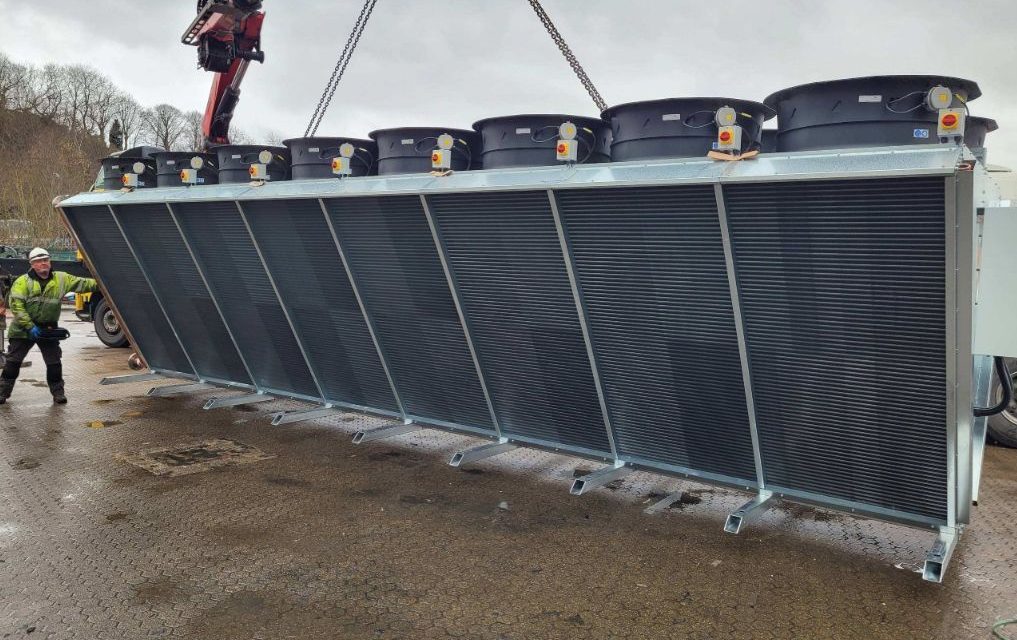
If your facility utilises dry-air or adiabatic cooling systems, they require unique seasonal maintenance. Serving as a cost-effective and environmentally friendly alternative to traditional cooling towers, adiabatic systems provide significant savings on water usage, require lower maintenance, and eliminate the need for continuous chemical dosing or registration with local authorities.
However, given their reliance on ambient air and water sprays, adiabatic systems can be highly vulnerable to sub-zero winter temperatures.
To safeguard adiabatic performance and prevent physical damage, engineers and production managers should follow a strict seasonal maintenance regime:
- Verify Glycol Concentration: Ensure the glycol concentration aligns with the lowest predicted ambient temperature. In food, beverage, or other sensitive applications, confirm that only food-grade glycol or approved fluids are used.
- Drain Non-Glycol Systems: In systems where glycol is absent, completely switch off, isolate, and fully drain all water from the circuits, spray lines, and pumps to eliminate any freeze risk.
- Apply Trace Heating: For exposed feed pipework that cannot be drained, inspect and test trace heating systems to ensure seasonal readiness.
- Filter and UV Maintenance: Clean filters and strainers to maintain clear flow, prevent blockages, and confirm the operational readiness of UV filtration units.
- Electrical Checks: Inspect electrical components, fan drives, sensors, and control panels, fitting protective weather covers where necessary.
Note: If your adiabatic cooling system is nearing 10 years of service or showing persistent signs of wear, it may be time to consider modern alternatives, such as freecooling chillers, to deliver superior performance and lower lifecycle costs.
Managing Dormant and Standby Equipment
For process cooling equipment left dormant or on standby during the winter months, the risk is not just freezing, but also the degradation of moving parts. Standing fluid can settle, causing internal seals to dry out and fail.
To mitigate this, regular circulation is essential. Program control panels to periodically cycle idle pumps to keep the internal components lubricated and prevent the fluid from settling.
If there is no glycol in the system, it is vital that the system pumps are programmed to continuously circulate the fluid whenever ambient temperatures drop below 3 °C. If sub-zero ambient temperatures persist for an extended period, the friction from continuous pump circulation will naturally heat the fluid. In this scenario, the system’s control logic should be configured to temporarily cycle the chiller back on to ensure fluid temperatures are controlled and remain within safe, designed limits.
Embracing the Cold for Energy Efficiency
With intense commercial pressure on UK businesses to reduce energy consumption and improve environmental sustainability, winter is the ideal time to embrace free cooling, which can benefit the operations throughout the entire year.

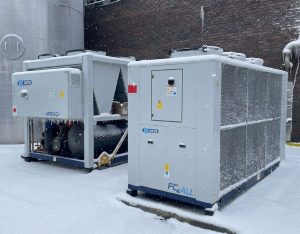
Any organisation using an externally sited chiller to cool their process can benefit from free cooling. This technology capitalises on low outdoor temperatures to cool the process fluid directly, completely bypassing the chiller’s energy-intensive mechanical compressors.
Free cooling can be implemented either by integrating a free cooling coil directly into an existing chiller or by installing a standalone, bolt-on unit. As the ambient air temperature falls, the cooling load on the chiller is progressively offset (partial free cooling). Once the ambient temperature drops to 5 °C below the process supply fluid temperature, the compressors shut down completely, and the entire cooling demand is met by the ambient air and fans (full free cooling). This is the cheapest and greenest way to provide cooling, often reducing winter energy use by up to 70%.
Free cooling shows how winter conditions can be turned from an operational challenge into an efficiency advantage. But the opportunity does not end there. There is a broader shift in how manufacturers can think about temperature control across the plant.
Thermal management: from separate systems to connected energy use
Traditionally, industrial heating and cooling have been managed in silos, with boilers generating heat and chillers rejecting waste heat to atmosphere. A more effective approach is to manage both as parts of one connected thermal system, where energy rejected in one part of the plant can be recovered and reused elsewhere.
This is the principle behind integrated thermal management. Instead of treating heating and cooling as separate demands, it looks at how they interact across the site. Many industrial processes require both at the same time, making waste heat recovery a practical way to reduce energy use, cut reliance on fossil fuels, and improve overall efficiency.
Modern heat pump technology makes this possible. Heat pumps can recover waste heat from chillers, compressed air, refrigeration, or ventilation systems and upgrade it for low- and medium-temperature heating, with outputs of up to 110 °C. Operating at efficiencies of 300% to 400%, they can deliver more than three units of useful heat for every unit of electricity consumed.
A Roadmap to Winter Readiness and Continuity Planning
Winterising a process temperature control system demands a comprehensive approach. Beyond the immediate physical need to prevent frozen pipework and equipment damage, winterisation represents a broader strategic opportunity to ensure long-term equipment health, optimise heat-transfer efficiency, and integrate sustainable upgrades.
It should also include contingency and business continuity planning. That means identifying critical thermal assets, assessing single points of failure, defining emergency response procedures, and putting practical backup measures in place, including access to temporary rental cooling or heating capacity where needed.
Unforeseen severe weather or sudden equipment failures can threaten operations despite the most rigorous maintenance regimes. Integrating rental equipment as a backup source, whether deploying emergency chillers or securing temporary heating resilience to get through the winter, ensures the facility can seamlessly bridge any gaps in temperature control. The right partner can provide a complete offering for winter resilience, acting as the one-stop shop needed to guarantee uninterrupted production through the harshest months.
Ultimately, redefining how heating and cooling systems are managed is vital. Understanding how energy flows through the site and using proven technology to recover, repurpose, and optimise that energy is a practical, ready-now way to improve efficiency, strengthen resilience, and reduce emissions without reinventing the plant – not only in winter.
By Dave Palmer, District Leader UK and Ireland, ICS Cool Energy