For UK manufacturers looking to futureproof their operations, increase productivity and mitigate labour shortages, automation offers significant opportunities
Yet, for companies that have never introduced automation, the prospect may seem daunting. Overly ambitious designs, unnecessary complexity and high upfront costs can quickly put investment plans on hold.
But taking the first step towards an automated factory does not have to be complicated. One often overlooked strategy is to start at the end of the production line and work backwards, beginning with one of the most straightforward and repeatable processes in manufacturing: packaging.
UK manufacturing’s hidden success story
Whether producing sandwiches, door handles or automotive components, almost every manufactured product needs to be packaged before leaving the factory. In many cases, that means handling standardised cardboard boxes. The closer a process gets to the individual product itself, the more complex automation can become. Boxes, by comparison, are predictable and relatively easy for robots to handle.

Repetitive tasks such as box handling, case packing, palletising and wrapping can often be automated with comparatively little disruption to existing operations
The UK packaging sector is a significant contributor to the national economy, accounting for more than £13 billion in sales, £6.2 billion in revenue1 and employing over 80,000 people2. Almost every manufacturing business is involved in packaging in some form, whether directly or through its supply chain.
Despite its importance, packaging is often overlooked when manufacturers consider where to introduce automation. Investment discussions frequently focus on complex pick-and-place applications at the beginning of the production line, where products can vary considerably in shape, size and handling requirements.
A more effective approach for first-time automation users is to focus on the packaging hall. Repetitive tasks such as box handling, case packing, palletising and wrapping can often be automated with comparatively little disruption to existing operations. Rather than attempting to automate everything at once, manufacturers can start with a manageable application that delivers measurable benefits while developing the knowledge and confidence to automate further processes.
Improving productivity while supporting the workforce
Robots are particularly well suited to dull, dirty and dangerous tasks. Lifting heavy boxes and stacking them onto pallets for an entire shift is repetitive, physically demanding and can place considerable strain on employees. Automating these activities can not only increase throughput, improve consistency and reduce bottlenecks at the end of the production line, but it can also ease the physical demands placed on employees and potentially lower the risk of handling-related injuries.
Staff can then be redeployed into more skilled, value-added roles, including quality control, machine supervision, maintenance and production improvement. This approach can also support workforce retention. Giving employees opportunities to develop new skills and move away from monotonous tasks improves job satisfaction, while reducing the time and expense associated with recruitment, onboarding and training.
Making the business case for automation
Cost remains one of the biggest barriers to automation investment. While packaging operations may appear relatively inexpensive because they often rely on entry-level labour, the true cost extends beyond wages; for example, National Insurance contributions, pensions, holiday and sick pay, training, workwear and recruitment.
Consider a manufacturer operating four production lines, each staffed by four full-time packing and palletising operatives. Using an illustrative annual wage cost of £25,000 per operative, the direct annual wage bill would be £400,000. An automated palletising solution costing £250,000 could, in theory, deliver a payback period of just 7.5 months.

Dan Fisher, Head of Sales, FANUC UK
While this is a simplistic calculation, it nevertheless demonstrates why packaging automation deserves serious consideration. And even when immediate labour savings are not the primary objective, increased throughput, greater reliability and better use of staff all make a compelling commercial case.
Choosing the right automation partner
However, although simpler than many other manufacturing processes, packaging lines typically combine several processes, including case erecting, product packing, box sealing, conveying, palletising and stretch wrapping.
Manufacturers should therefore look for an automation partner with established relationships across the wider packaging supply chain. Proven collaboration between robot suppliers such as FANUC and our system integrator partner network, who are providers of conveyors, box erectors, tape sealers and stretch wrappers, will help ensure that equipment works together as a cohesive system, reducing integration risks and supporting a competitive overall solution.
Collaboration is particularly important when businesses are considering changes to packaging materials. Consumer demand for recyclable packaging and ongoing legislative pressure is encouraging manufacturers to rethink the materials they use, and these changes create an opportunity to review production processes at the same time.
By considering automation alongside packaging redesign, manufacturers can address these challenges before new materials are introduced at scale. Packaging consultants and material suppliers should therefore aim to work closely with automation providers from the outset, reducing the need for costly modifications later on and reducing the change burden.
Extending automation into distribution
While many manufacturers will have their own packing facilities, some use third-party logistics providers and distribution centres to store products and manage fulfilment. In some cases, products are packaged or prepared for dispatch only when customer orders are received. These co-packing and distribution operations often involve high volumes of repetitive work, making them strong candidates for automation.
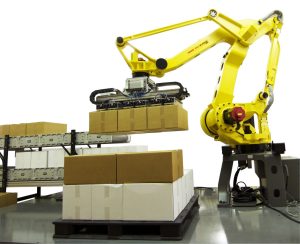
One often overlooked strategy is to start at the end of the production line and work backwards, beginning with one of the most straightforward and repeatable processes in manufacturing: packaging.
Integrating robotic equipment with warehouse management systems, enterprise resource planning (ERP) platforms and order fulfilment software can improve coordination between inventory, packaging requirements and dispatch schedules. With the right integration, businesses can increase visibility, reduce manual handling and make more efficient use of their labour and equipment.
Start small, think strategically
In conclusion, for any manufacturer that has yet to embrace automation, transforming an entire factory may feel overwhelming. Packaging provides a more accessible starting point, with repetitive processes and established robotic solutions offering opportunities for practical, measurable improvements.
By starting at the end of the production line, firms can build internal expertise, improve productivity and develop a clearer understanding of how automation can support their wider business objectives. The key is to define the operational challenge, assess the potential return and involve the right technology partners from the outset.
Automation does not have to begin with the most complex process in the factory. For many companies, starting with packaging could be the most effective way to improve efficiency, support the workforce, respond to sustainability demands and compete more confidently in a global market.
For more help around taking your first steps towards automation, join FANUC UK’s Open House on 3-4 November 2026 at Ansty Park in Coventry.
Register for free at: https://events.fanuc.eu/Automation_that_works_for_you-dup