Plastics decoration has traditionally happened after injection moulding
Parts are produced first, moved to a separate finishing area and then decorated using pad printing, screen printing, coatings or other downstream techniques. For many manufacturers, this has been the accepted approach for years. Here, Nigel Smith, CEO of TM Robotics, explains why plastics decoration should no longer be treated only as a secondary finishing process, and how robotics can help manufacturers bring decoration closer to the moulding press.
As production becomes more automated, flexible and sustainability-focused, the separation of moulding and decoration is beginning to look less practical. Moving parts between processes adds handling time, increases the risk of damage and can make it harder to maintain a smooth, repeatable production flow.
External pressure is also increasing. The European Commission states that packaging accounts for 40 per cent of plastics used in the EU, while the Packaging and Packaging Waste Regulation aims to make all EU packaging recyclable by 2030 and increase the use of recycled plastics. This underlines a wider shift towards connecting product design, material choice, recyclability and production processes.
A more integrated approach is now emerging, bringing decoration closer to the moulding press and using robotics to make the process faster, cleaner and more adaptable.
One example is T-TRANSFER, a patent-pending plastics decoration system developed by Italian start-up Roboprint, Shibaura Machine and TM Robotics after meeting at MECSPE in Bologna. Sharing a goal to make plastics decoration more efficient and sustainable, the companies began joint development trials supported by Tiesse Robot and BBS robot.
“The partnership combined our printing expertise with Shibaura’s precision robotics and TM Robotics’ support network,” said Valter Scolaro, founder of Roboprint. “Together, we’ve created a solution that meets the industry’s growing demand for flexibility and sustainability.”
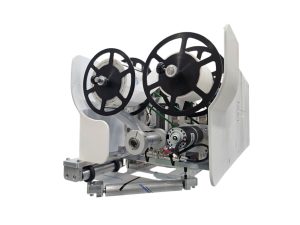
Following successful demonstrations at Shibaura Machine’s Solution Fair in Japan, the concept evolved into a fully integrated, patent-pending system that combines Roboprint’s print head and control software with Shibaura Machine robotics. At the heart of the process is a heated silicone pad mounted on a Shibaura Machine 6-axis robot, such as the TVM900. The pad applies pre-printed designs from protective reels directly onto three-dimensional plastic surfaces using controlled heat and pressure.
Unlike conventional pads or screen printing, the process does not use liquid ink or solvents. This removes the need for chemical handling and cleaning, while supporting a cleaner production environment. Designs can be stored on reels for up to a year, allowing manufacturers to hold different logos, patterns or colourways and switch between them more easily.
The practical benefit is that decoration can take place directly at the moulding press. Instead of moulding components, transferring them to a separate area and then decorating them, manufacturers can bring finishing into the automated production sequence. This reduces manual handling, lowers the risk of part damage and helps keep production moving in a more controlled way.

For manufacturers producing higher volumes or frequent product variations, this flexibility is particularly valuable. Cycle times are typically five to six seconds per part, depending on the material and geometry. Multiple decorations can also be applied to different areas of a component in one cycle, making the technology suitable for parts with complex shapes or more demanding visual requirements.
The sustainability argument is also important. Removing solvents and liquid inks can reduce chemical use on the shop floor. The use of pre-printed reels removes the need for additional coatings, meaning finished parts can remain recyclable. The heated pad also replaces more energy-intensive pre-treatment methods such as flaming or plasma, helping reduce energy use and process complexity.
Automation is what makes the process repeatable. The robot provides accurate and consistent positioning, while Roboprint’s system manages the print head and decoration process. This combination allows manufacturers to decorate complex 3D surfaces with the accuracy required for industrial production, rather than treating decoration as a separate craft process.
The technology also points towards a broader future for plastics decoration. Under the EU’s Ecodesign Regulation, Digital Product Passports are expected to provide essential sustainability information for regulated products. This reflects a wider move towards product-level data, traceability and transparency.
Roboprint and its partners are already exploring intelligent transfers that could embed RFID tags or sensors within decorative films. This could allow components to carry data for traceability, authentication or recycling information.
“This is where decoration meets digital manufacturing,” said Martina Scolaro, commercial manager at Roboprint. “By combining robotics with data-enabled design, we can make plastics decoration not just cleaner and faster, but smarter too.”
For plastics manufacturers, the message is clear. Decoration is no longer just about appearance. Technologies such as T-TRANSFER can support traceability, sustainability, production efficiency and product differentiation. But to unlock those benefits, decoration must be considered as part of the wider manufacturing cell rather than a process that happens afterwards.
To learn more about T-TRANSFER and Shibaura Machine injection moulding technologies, visit the TM Robotics website.
To read up on more of the most recent manufacturing coverage, take a look at Irish Manufacturing’s News Page