

Rising costs are forcing manufacturers mean manufacturers can no longer afford to absorb inefficiencies have previously gone unnoticed and unaddressed. This shift is placing attention beyond product reformulation for money saving measures. Having a thorough look at a processing line efficiency and identifying areas which could be improved could be the key to increasing profitability without the need for reformulating products with cheaper substitute materials. In this article, we will be exploring how the efficiency of mixing equipment in the production line can have an impact on costs and product quality.
Mixing powders into liquids can be a challenging task, one which only becomes more difficult, and costly, when using the incorrect mixing equipment. Ingredients such as gums and thickeners, often used in conjunction with one another, can have a substantial commercial impact on a manufacturing process if not incorporated correctly. Not only can these ingredients be expensive, but one of the most common cost-related issues is poor powder incorporation during mixing, which if left unaddressed can lead to substantial amounts of wasted product and increased processing times.
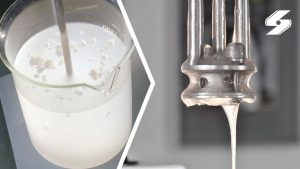
Powdered ingredients are prone to clump or agglomerate on contact with liquid, preventing full dispersion and creating inconsistencies throughout the batch. Manufacturers often increase processing times by premixing powders with other ingredients before mixing to try and help aid incorporation or by slowly adding the powders to the liquid to try and avoid the formation of agglomerates. Where agglomerates cannot be broken down by the mixing equipment, a filtration stage is often added after mixing, again prolonging processing times. These problems can extend beyond the mixing stage itself. Poor dispersion or uneven hydration can lead to variations, instability and inconsistencies in the finished product.
In some cases, manufacturers compensate by increasing raw material usage, which raises ingredient costs without necessarily resolving the underlying processing issue – in this case the mixing equipment. In the case of one customer encountered by Silverson Machines, the manufacturer had to look at their processing efficiency once it became too expensive to sustain their recipe due to a high percentage of pectin in the formulation. The pectin itself was becoming more and more costly, so something in their process needed to change.
The customer had been using a conventional agitator to mix pectin into a base liquid. The mixing stage alone was taking upwards of 40 minutes to complete. And the agitator they were using was so inefficient at dispersing the powder that the operators were adding up to 20% more pectin than was needed to account for what was being lost. The agitator could not break down agglomerates once they had formed and did not produce sufficient movement in the tank to stop partially hydrated pectin from sticking to the agitator shaft, blades and walls of the mixing vessel.
The resulting product was a poor quality 5% pectin solution, wasting 20% of the expensive raw materials added. Coupled with the long mixing times, this wastage was costing the company a considerable amount of money. It was evident that the mixing stage of their process was an area which could be vastly improved.
Trials were undertaken using a high shear powder/liquid mixer in place of the conventional agitator. Unlike conventional mixers or agitators, high shear mixers utilise specialised rotor/stator technology to generate extremely high shear rates, creating a powerful suction effect that continuously draws materials into the high shear workhead. Whereas the conventional agitator continually moved the unhydrated pectin around in the vessel, during the high shear mixer trials the powders were drawn straight into the high shear workhead, where they were subjected to intense high shear. This achieved full dispersion and rapid hydration of the pectin before agglomerates could form, achieving the full yield of thickening effect.
In the trials carried out, 5% of pectin was quickly incorporated and after a short recirculation period, hydration was complete. The customer was able to achieve the results they wanted with no need to add excess amounts of powder. Incorporating 5% pectin quickly and effectively meant a 20% reduction in pectin compared to their previous process with the agitator. The cost implications of this were huge, so much so that the high shear mixer would pay for itself many times over with the savings made on the raw material. In addition, further money would be saved due to the shorter processing time and lesser energy consumption.
If you’d like to talk to a Silverson mixing expert about how high shear mixer could improve your manufacturing process, please get in touch at: sales@silverson.co.uk


